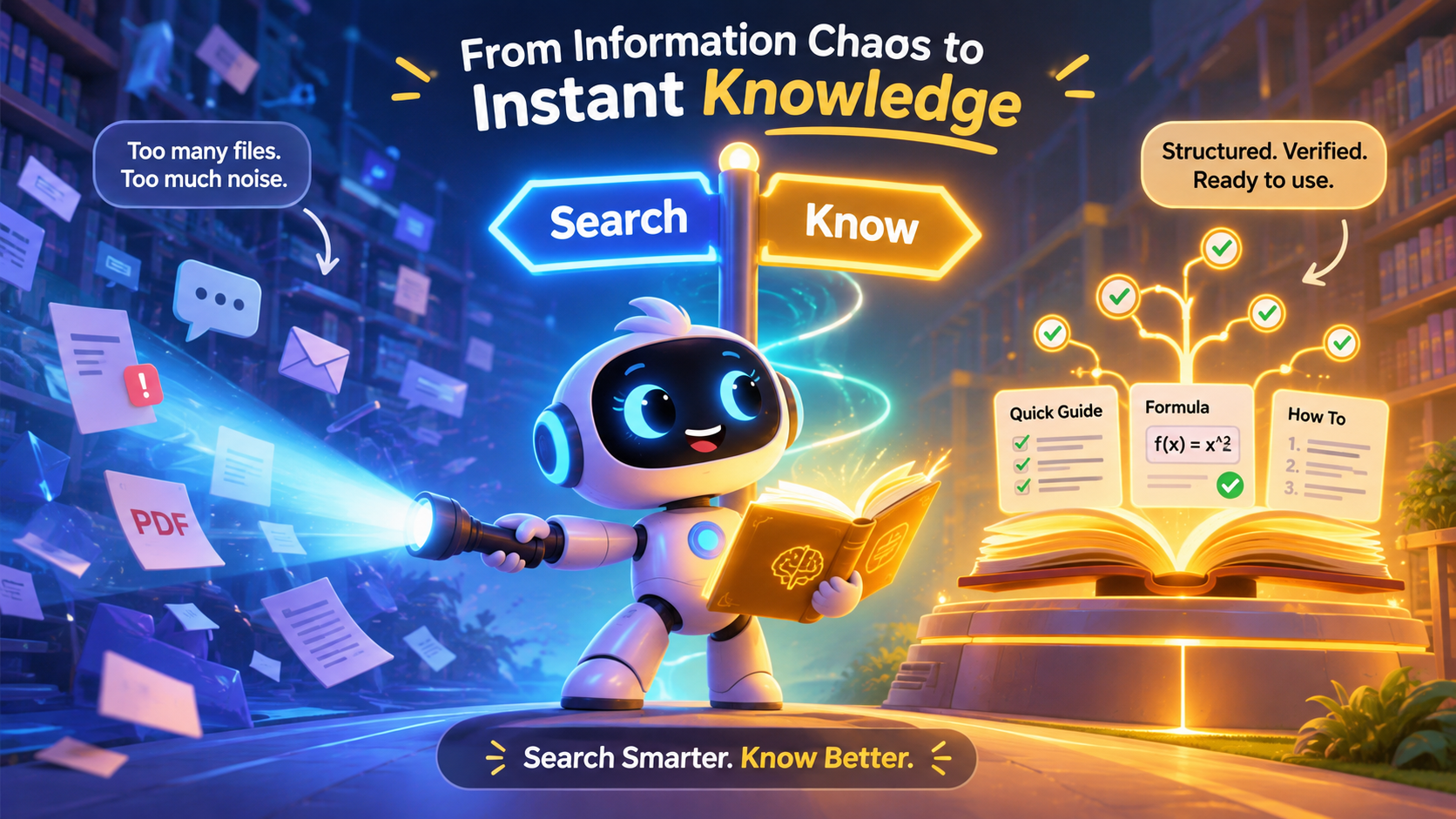
Meet Ria, a brand-new AI assistant on her first day at a busy company. Within an hour, three people come to her. The finance head needs the official churn formula for the board deck. A support lead wants to know what customers have been complaining about this month. An engineer needs the exact steps to restart the payments server.
Ria carries two tools. The first is a flashlight that sweeps through a giant warehouse of emails, chats, PDFs and meeting notes, lighting up anything that looks related. The second is a slim golden handbook, written and checked by the company's own experts, where every page holds one official answer.
That, in one picture, is the OKF vs RAG debate.
The flashlight: RAG
Retrieval-Augmented Generation (RAG) has been the standard way to give AI access to company knowledge for the last few years. Documents are cut into small pieces, turned into numbers that capture their meaning, and stored in a special database. When a question arrives, the system pulls out the pieces that look most similar and hands them to the AI.
RAG's superpower is reach: it can dig through millions of messy documents no human would ever organise. Its weakness is that "similar" is not the same as "correct." If three old chat threads describe the churn formula three different ways, the flashlight may land on the wrong one, and the AI will repeat it with total confidence.
The golden handbook: OKF
In June 2026, Google Cloud published the Open Knowledge Format (OKF), an open, vendor-neutral specification for writing down the knowledge AI agents need. An OKF "bundle" is simply a folder of Markdown files. Each file covers one thing (a metric, a database table, an API, a runbook) and carries a small block of labels at the top that machines can read.
Because these files typically live in Git, every change is reviewed, tracked and reversible, just like code. And because it's plain text, any model, agent or human can read it without special software. Google's own description: a format, not a platform. Where RAG guesses what's relevant, OKF lets the agent walk straight to the approved answer.
So which one wins?
Neither, and that's the real story. Back to Ria:
- Churn formula? She opens the handbook. One page, one approved answer.
- Customer complaints? She switches on the flashlight. The answer is scattered across hundreds of tickets, and only search can find it.
- Server restart? She follows the handbook's runbook, step by step.
Many teams now put a simple "router" in front of their agent: check the curated OKF knowledge first, and fall back to RAG search when the question is open-ended.
The catch
OKF is only as good as the people who maintain it. An outdated handbook page is just a confident mistake with nicer formatting. RAG, meanwhile, still depends on good chunking, ranking and fresh data. Neither removes the need for humans to own their knowledge.
Why it matters
The takeaway for any business is simple: decide which facts must never be wrong, write them down carefully, and let search handle everything else. AI agents are moving from impressive demos to real work, and the winners will be the companies that give them both a flashlight and a handbook.